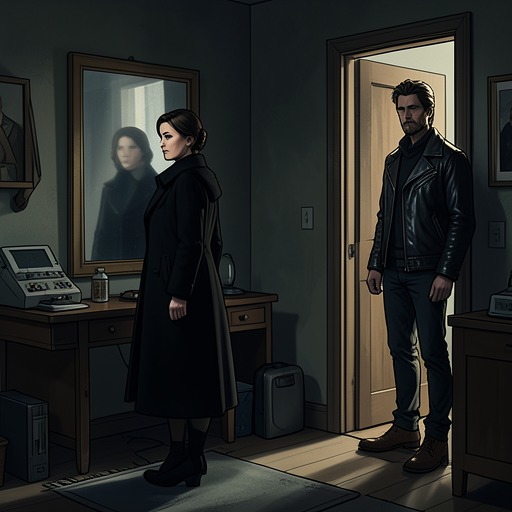
Kate Puts Responsibility Before Her Own Wishes
Slow BurnKate Puts Responsibility Before Her Own Wishes is a recurring pattern in Kate MacKenna’s choices, not simply a single act of sacrifice. She reasons against a relationship with Dylan Buchanan by imagining its eventual end and the pain it could cause them both; elsewhere, Carl Bertolli describes how family responsibility has kept her from pursuing the career she once planned in Boston. Her sense of duty gives her decisions a clear logic, but that logic repeatedly places other people’s needs—and the consequences she anticipates—ahead of her own desires.
Love Framed as Foreseeable Harm
When Dylan Buchanan challenges the mismatch between Kate’s resistance to his touch and her jealousy at the thought of him speaking to a woman back home, Kate answers by making the future, rather than the present attraction, decisive. She acknowledges his enjoyment of flirting, then argues that a relationship would be a disaster: he will eventually return home, he would feel terrible if he hurt her by ending things, and she would feel terrible if she ended things and hurt him. In her calculation, mutual pain is foreseeable, so beginning the relationship is not worth the risk.
That argument turns restraint into a form of care. Kate does not deny that Dylan Buchanan matters to her; instead, she treats their possible happiness as less important than preventing a future injury. The certainty of her forecast is striking: before a relationship can unfold, she has already supplied its ending and assigned herself responsibility for the hurt on both sides. Dylan Buchanan’s observation that she has left Jordan Buchanan out of her explanation this time unsettles her. Kate’s startled request for clarification shows that he has noticed a recurring rationale, though this exchange does not spell out what earlier arguments involving Jordan Buchanan contained.
Inheritance and Continuing Obligations
The inheritance paperwork does not make Kate’s practical concerns disappear. After putting folders into a briefcase, she is asked what she will do with the money once the papers are signed. She says she needs to go to a bank in Silver Springs. When Anderson Samuel Smith assumes she means to transfer the money there and says he can arrange it, Kate corrects him: she needs to obtain a loan. The exchange distinguishes receiving or moving money from securing credit. Even at a moment organized around the inheritance, Kate has another financial task to handle, rather than simply treating the estate as a solution to every problem.
This detail complicates any simple picture of inheritance as freedom from constraint. Kate’s answer is brief, but its correction matters: the immediate errand is not the transfer Anderson Samuel Smith expects, but a loan. The scene supplies no further terms for that borrowing, so it cannot establish exactly how she intends to use the money. It does show her attention turning quickly from the papers in front of her to the next obligation she believes she must meet.
Family Duty and the Career She Set Aside
Carl Bertolli’s account gives the clearest description of what Kate’s responsibility has cost professionally. He explains that he concealed his ownership of the warehouse because he hoped to offer it through a Realtor at a substantially reduced price and help her. He sees her as a businesswoman with considerable promise: she had been on a fast track, had grand plans, and had connections in Boston. In his estimate, moving the company there could have made it a major industry presence within a year and brought its products around the world within five. These are Carl Bertolli’s projections, not outcomes the story confirms, but they establish the scale of the future he believes Kate could have pursued.
Carl Bertolli says she will not move the company now because she is responsible. His account connects that quality first to her mother and then to Isabel MacKenna: Kate stayed for her mother, and now, in his view, she will stay for her younger sister. He expects her to remain in Silver Springs for at least two or three more years. That estimate makes the sacrifice concrete as a period of time, while also showing how care for family becomes a limit on the professional choice available to her.
Carl Bertolli does not regard remaining in Silver Springs as proof that Kate’s ambitions are over. He hopes she will stay permanently and expand the company there, helping put the town on the map. He concedes that international success might take longer from Silver Springs, but believes Kate’s drive and determination could still carry her there if that is what she wants. His support therefore holds two possibilities together: the local business offer is meant to help her, yet he recognizes that its value depends on what Kate herself wants. His own belief that this is where she belongs sits beside his admission that she could succeed wherever she goes.
The Personal Cost of the Pattern
Kate’s private thoughts reveal a pain that her arguments about responsibility do not resolve. Restless and melancholy, she recognizes that Dylan Buchanan is what is wrong: she wonders how long it will take to stop loving him and whether she might remain miserable for the rest of her life. She also tells herself there is no one to blame but herself. In her view, Dylan Buchanan has always been clear about the way he lives: he loves them, and he leaves them. Rather than treating his departure as a surprise or an excuse, she sees it as a known risk she accepted by falling in love.
Her self-judgment sharpens the contrast between the orderliness of her reasoning and the force of the feeling beneath it. She calls herself a complete idiot for having fallen in love, even as she knows that Dylan Buchanan made no false promise about staying. Responsibility here is not only practical care for family or business; it is also the burden Kate takes on for her own unhappiness. Across love, work, and money, she anticipates what others may need or what may go wrong, then tries to make the least harmful choice. The pattern protects those around her from some consequences, but it does not spare Kate the cost of wanting a different life.